Are Extended Producer Responsibility Laws Just Paper Tigers for Plastic Packaging?
Plastic waste is everywhere—from oceans to alleyways to the microplastics in our drinking water. In response, policymakers around the world have embraced Extended Producer Responsibility (EPR) laws as part of the solution. These laws shift the burden of managing post-consumer waste from taxpayers and municipalities to the companies that make the packaging in the first place.
But as EPR laws spread, critics ask a pointed question: Are they powerful tools for change, or just paper tigers—well-intentioned but toothless? Nowhere is this debate more visible than in the realm of plastic produce containers and similar packaging, which represent both a waste management challenge and a major design opportunity.
What Are EPR Laws, Anyway?
At their core, EPR programs require producers to:
-
Finance the collection and recycling of their products,
-
Design packaging with end-of-life in mind,
-
Reduce waste and encourage reuse when feasible.
Some EPR laws also set recycling targets or require reporting and transparency in how much waste is generated and recovered.
In theory, that’s a powerful shift. Instead of society dealing with the aftermath of waste, companies face financial incentives to reduce it. As of 2025, the following states have some type of EPR laws on their books:
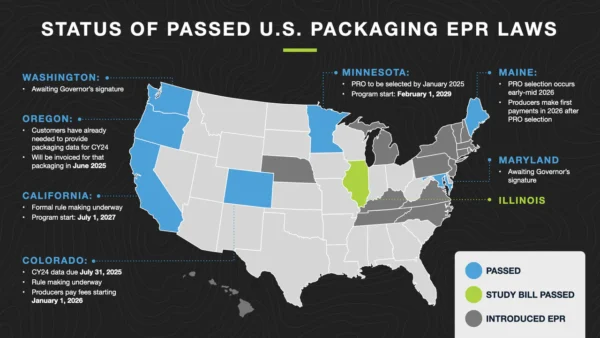
Image from anewearthproject.com
The Case Against EPR: Paper Tiger Critics
For plastic produce containers and packaging, skeptics raise several common points:
1. Minimal Impact on Design Innovation
Many EPR systems don’t push companies hard enough to redesign products for recyclability or reuse. Packaging can still be complex multi-layer plastic that’s technically recyclable but rarely recycled.
2. Weak Enforcement
Without strong enforcement or penalties, companies may treat compliance as a cost of doing business rather than a catalyst for real change. Some laws rely heavily on self-reporting, which can be opaque and difficult to verify.
3. Limited Infrastructure Improvements
Producers may pay into a central fund, but that doesn’t guarantee better recycling infrastructure where it’s needed most. If recycling facilities aren’t upgraded, more money doesn’t always mean more effective recycling.
4. Blurred Accountability
When EPR programs pool contributions from many companies, it can be hard to see who’s actually driving progress. This can dilute the incentive for individual brands to innovate.
5. Continued Plastic Production
EPR doesn’t inherently restrict the volume of plastic produced—it mostly focuses on handling waste after the fact. If more plastic continues to be made, the problem keeps growing.
Taken together, these concerns fuel the idea that EPR might be more symbolic than substantive—a policy that looks strong on paper but struggles to deliver deep, systemic change.
The Case For EPR: Why It Still Matters
Despite the criticisms, EPR laws are not without teeth—and they’re far from irrelevant.
1. Financial Incentives Shift Costs
EPR removes the subsidy that taxpayers traditionally pay for waste management. Producers now must internalize those costs, which can make waste more expensive and push companies to cut back.
2. Growing Policy Momentum
Countries and regions are increasingly adopting stronger, more ambitious EPR frameworks. This creates a race to the top where companies operating in multiple markets must adapt across the board.
3. Transparency & Reporting
Even imperfect reporting requirements give regulators and the public better data. Over time, this transparency can spotlight laggards and reward leaders.
4. Foundation for Future Policy
EPR isn’t a finish line—it can be a stepping stone to more aggressive rules, like minimum recycled content requirements, outright bans on problematic plastics, and mandates for reusable packaging systems.
Real World Challenges for Plastic Produce Packaging
Plastic containers for berries, greens, and other produce have become emblematic of the problem:
-
They’re lightweight and often not accepted in many recycling programs.
-
They’re made of PET or PCR plastics that require specific sorting.
-
Food contamination often leads facilities to reject them.
Without robust recycling markets and standardized collection systems, the EPR fees paid by producers sometimes just get funneled into general waste programs without materially increasing the recycling rate for this type of packaging.
That’s a key reason critics say EPR can be a paper tiger: money changes hands, but plastics don’t necessarily stay out of landfills or the environment.
How to Strengthen EPR from Paper Tiger to Power Player
If EPR is to be more than symbolic, it needs muscle. Here’s what that looks like:
1. Clear, Measurable Outcomes
Set recovery and recycling rate targets for specific materials like PET clamshells, with accountability if targets aren’t met.
2. Design for Circularity
Incentivize or mandate design changes—minimal materials, mono-materials, and compatibility with existing recycling systems.
3. Support for Infrastructure
Ensure producer fees are earmarked for infrastructure upgrades—not just general waste services.
4. Transparency and Public Reporting
Independent auditing, public dashboards, and brand-level performance reporting can create market pressure.
5. Link EPR to Broader Policies
Pair EPR with recycled content, reuse systems, and outright bans on the worst inert plastics.
Conclusion: Not Just a Paper Tiger—But Not a Silver Bullet
The idea of Extended Producer Responsibility is powerful. It flips an outdated cost structure on its head and forces producers to think beyond the point of sale.
But when it comes to plastic produce containers and similar packaging, EPR alone—especially in weak or poorly enforced form—can fall short. Without clear outcomes, strong enforcement, and complementary policies that drive real redesign and infrastructure investment, EPR risks being more symbolic than transformative.
So are EPR laws paper tigers? Sometimes. But they don’t have to be. When well-crafted and paired with broader systemic change, they can be a tool that bites back at the problem of plastic waste.